
A twisted chronicle of fame fabrication in the digital age, where algorithms replace autographs and the barrier between stars and nobodies dissolves into mathematical probability
The human brain was never designed to handle fame. Celebrity is a modern parasite that feeds on our tribal instincts, convincing us that distant strangers in expensive clothes somehow matter to our immediate survival.
I've spent three deranged weeks exploring the bizarre new frontier where technology has finally solved the celebrity access problem through a solution so fundamentally demented it could only emerge from our current techno-hellscape: if you can't meet the celebrities, simply fabricate evidence that you did.
THE DIGITAL AUTOGRAPH HOUND
"I've had dinner with Robert De Niro seven times this month," explains Martin, a 34-year-old accountant from Phoenix whose life is spectacularly ordinary in every way except one: his phone contains photographic "evidence" of encounters with roughly 200 A-list celebrities.
"Here's me and Meryl Streep at a cafe in Paris," he says, displaying an image so convincing it triggers an involuntary pang of jealousy despite my complete awareness of its fabrication. "And this is Ryan Gosling and me playing chess in Central Park."
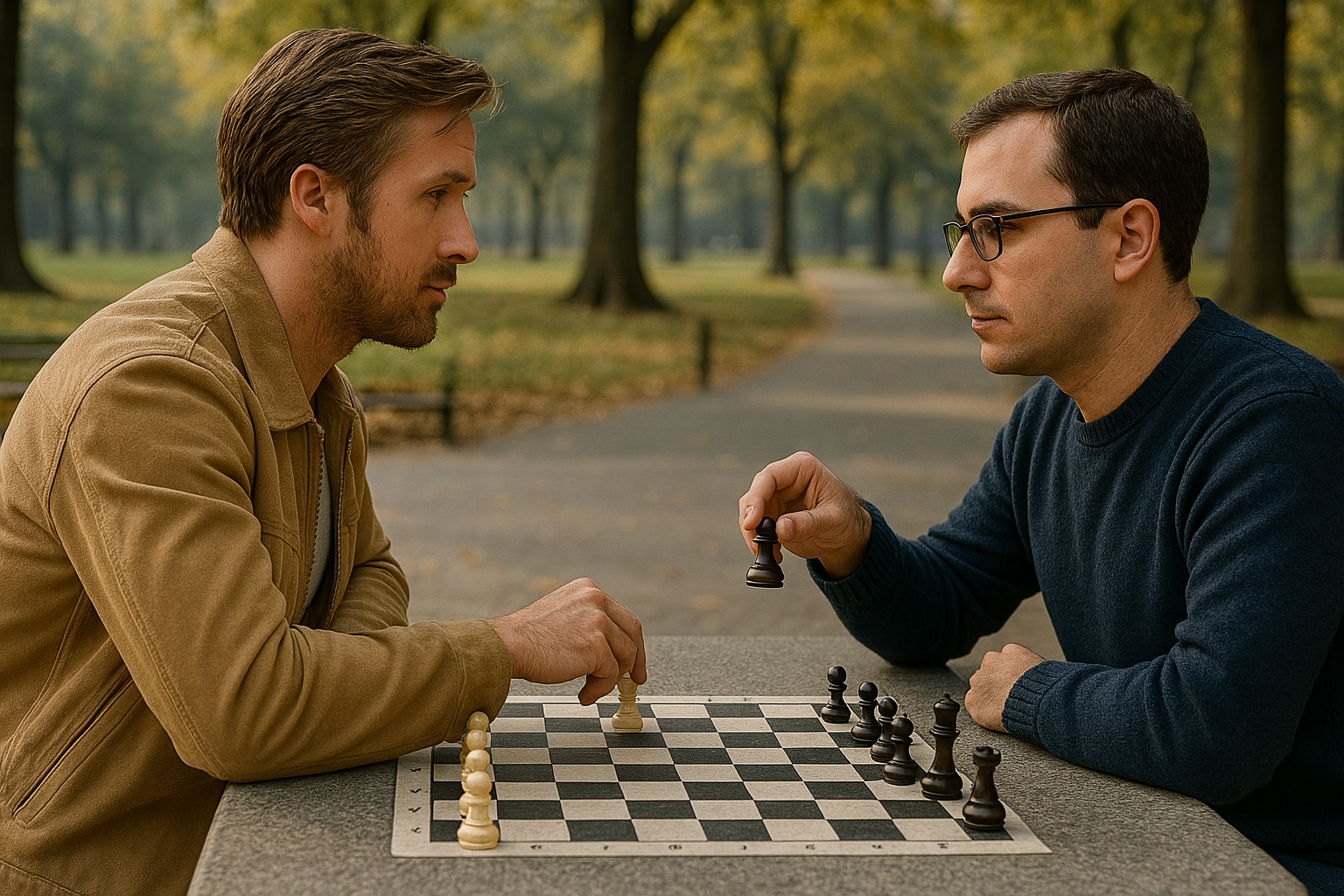
The Great Chess Hallucination: an accountant from Phoenix challenges Gosling to a battle of wits that never occurred in any timeline known to cosmic reality.
The images are flawless—lighting, composition, expressions all perfect. Even the subtle details are there: the correct seasonal clothing, the appropriate backgrounds, the convincing body language of two people who appear completely comfortable in each other's presence.
"I use pictopia," he explains, referring to the AI image generation platform that has transformed the parasocial relationship into something even more psychologically complex. "I've got the prompting down to a science. The trick is specificity without overconstraining the model."
Martin isn't delusional—he knows none of these encounters happened. But as he swipes through hundreds of manufactured memories, the line between knowing and feeling begins to blur around the edges. His voice softens when he discusses certain celebrities, as if recalling fond memories of real friendships.
"Tom Hanks is exactly as nice as you'd expect," he says, showing me a series of images depicting him and Hanks painting a fence together. The statement hovers in conversational space, neither true nor entirely false—a quantum superposition of celebrity experience.
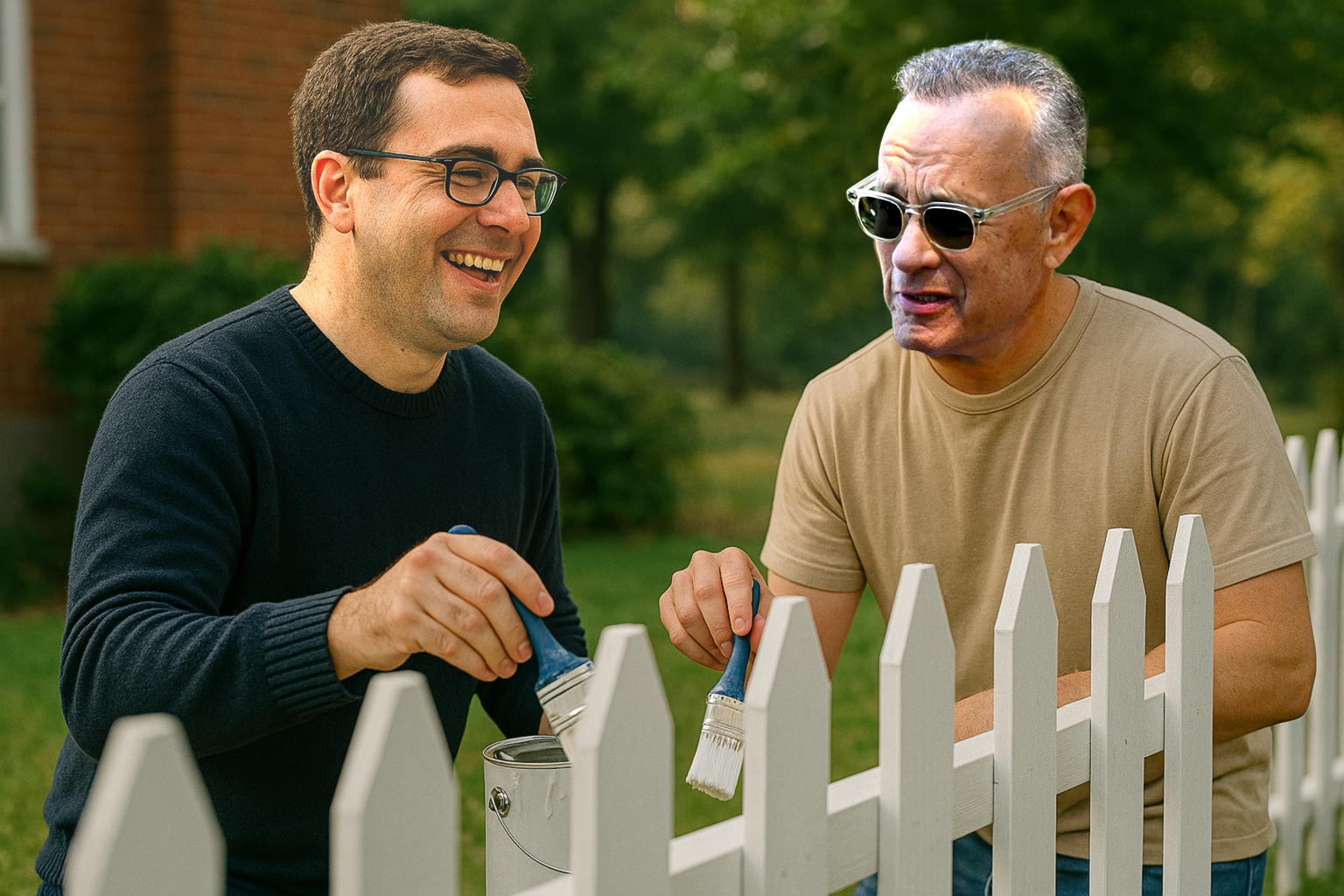
The American Dream 2.0: Tom Hanks teaches suburban fence maintenance in an encounter fabricated entirely by machines that have never held a paintbrush.
THE FAME PROXIMITY EFFECT
"These aren't just fantasy images—they're memory prosthetics. They create the emotional residue of experiences that never happened," explains Dr. Eleanor Reid, who studies parasocial relationships at UCLA.
She points to research showing that merely looking at photographic evidence of fictional events can implant false memories so convincing that subjects will defend their authenticity even when confronted with contrary evidence.
"What we're seeing with these AI-generated celebrity encounters is a deliberate self-implantation of false memories. The subjects know intellectually that these events didn't occur, but the emotional centers of their brains don't process that distinction with the same clarity."
For centuries, proximity to fame required actual proximity—you needed to be in the same physical location as the celebrity. Now, that barrier has collapsed into algorithm. Anyone with a smartphone can generate unlimited "evidence" of intimate connections with the famous. It's democratized delusion.
THE COLLECTOR'S DISEASE
"It started as a joke," admits Rebecca, a marketing executive from Chicago whose apartment walls are covered with framed photos of her with celebrities—all generated through AI. "I made one image of me with Beyoncé at a birthday party, just to see if it would look real."
"Now I have a complete alternative social life," she says, gesturing to the gallery that surrounds us. "Me at the Oscars after-party. Me backstage with Taylor Swift. Me having brunch with the cast of 'Succession.'"
"I know it's not real," she insists, though her eyes linger on the images with an unsettling affection. "But it's not exactly fake either. It's...adjacent to reality. Like dreams you can see."
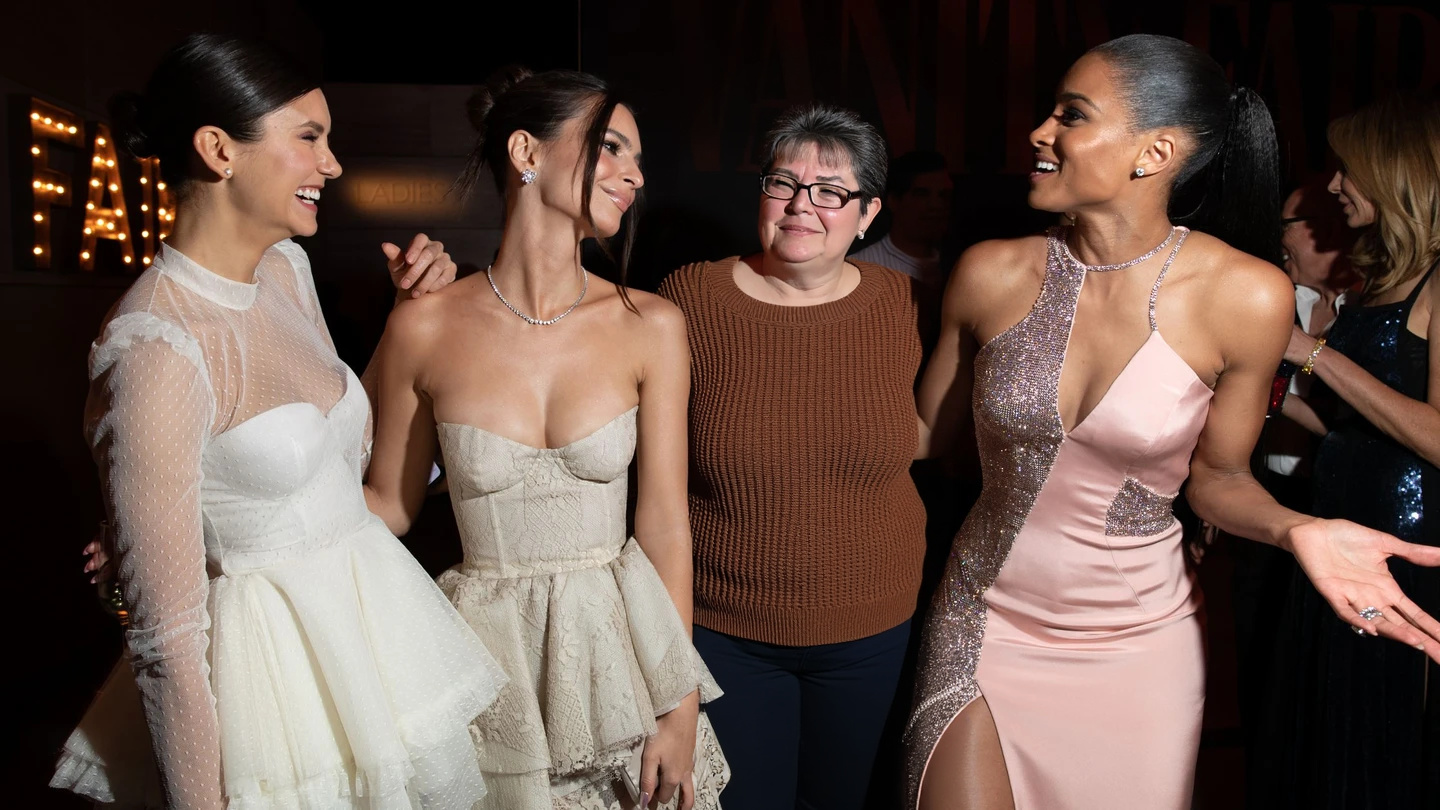
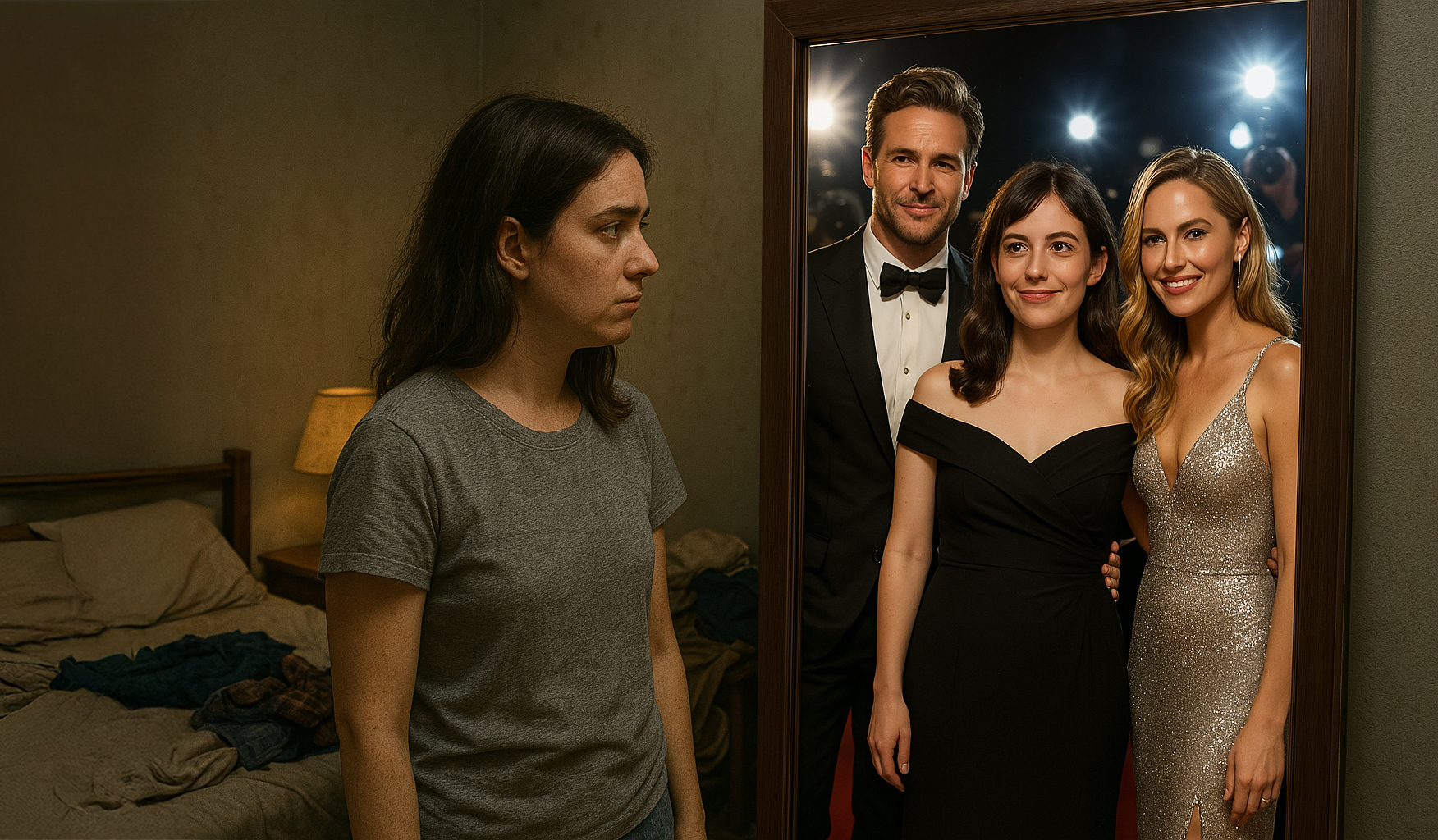
Hollywood's strange adoption ritual: three creatures bred for camera lenses flanking a normal human who digitally crashed the velvet rope barrier without leaving her couch.
THE BLURRED BOUNDARY
In a private Discord server dedicated to "celebrity adventures," I meet users who speak about their generated encounters as if recounting actual experiences. They share "memories" of conversations that never happened, insights supposedly gleaned from fabricated intimate moments with the famous.
"Christian Bale gave me some excellent advice about my career when we were hiking in Runyon Canyon," writes one user, attaching a perfectly rendered image of himself and Bale sitting on a hilltop overlooking Los Angeles. The following discussion isn't about the technical quality of the image but about Bale's supposed career wisdom—as if the encounter contained actual content beyond its pixels.
The server moderator acknowledges the increasingly blurry line: "We have to remind people sometimes that these aren't real encounters. But I think most users are playing along with the fantasy rather than actually believing it. It's like an improved version of fan fiction where you're the main character and it comes with visuals."
But the quality of those visuals makes the distinction increasingly academic. When the evidence is indistinguishable from reality, the psychological impact follows suit.
THE CELEBRITY DEFENSE MECHANISMS
"It's entirely weird," admits a B-list actor who requested anonymity. "I've had people approach me at events referring to conversations we've supposedly had, showing me pictures of us together at places I've never been. The first few times it happened, I thought I was losing my mind."
Some stars have begun to include "AI image identification" as part of their security briefings. Teams are being trained to recognize the subtle markers of AI generation—though these indicators are becoming increasingly difficult to spot as the technology improves.
"My team found an entire website dedicated to fabricated images of me with the site creator," shares a television actress. "Hundreds of images spanning years of a relationship that never existed. The disturbing part wasn't just the images—it was the detailed backstory about how we met, our favorite restaurants, vacations we'd taken together. A complete alternative history."
Legal teams are struggling with how to approach the issue. While defamation and false light laws exist, they weren't designed for a world where anyone can generate convincing "evidence" of non-existent relationships.
MY OWN DESCENT INTO SYNTHETIC PROXIMITY
Journalistic integrity demands experimentation. At least that's what I told myself as I downloaded pictopia and began my own exploration of manufactured celebrity encounters.
The first one was conservative—just me and George Clooney having coffee. Nothing implausible, nothing that suggested particular intimacy. Just two people who might reasonably have found themselves at the same cafe.
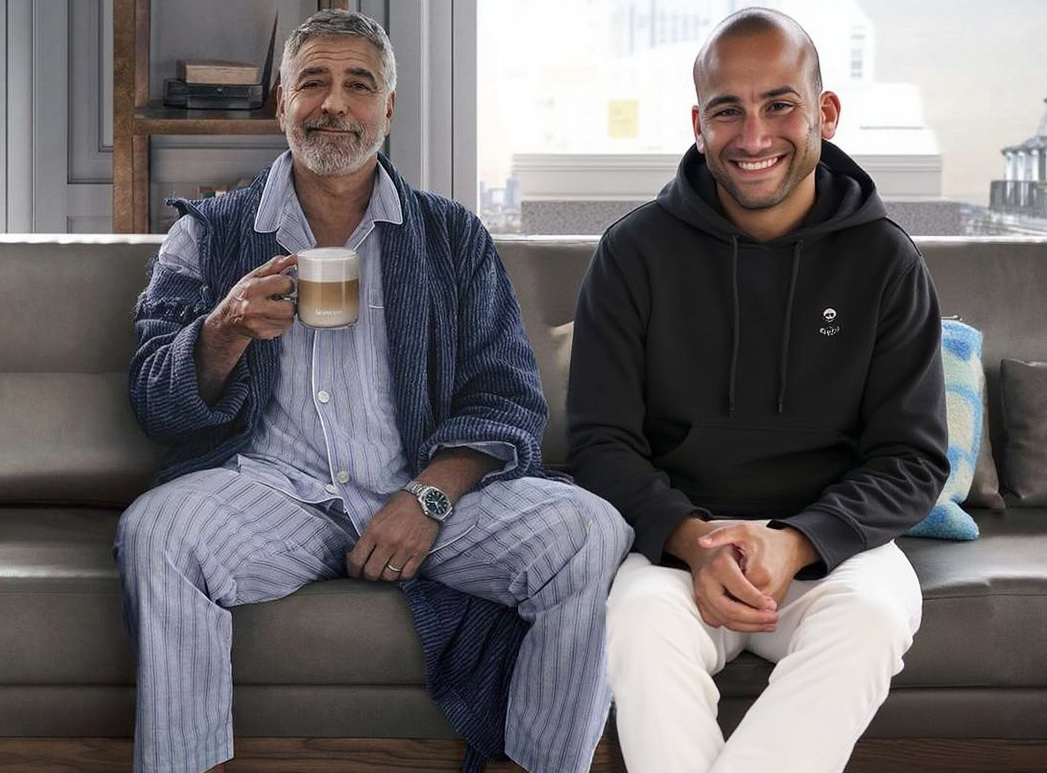
The caffeine conspiracy at work—Clooney unaware he's participating in this psychedelic fiction of casual celebrity proximity while I order the third espresso that actually happened.
The result was unnervingly convincing. Not perfect—something about the way the light hit Clooney's face wasn't quite right—but certainly good enough to make a casual observer believe the encounter had happened.
By the seventh generation, I'd abandoned all pretense of plausibility. Me and Einstein riding roller coasters. Me teaching Marilyn Monroe how to use a laptop. Me and Shakespeare comparing notes in what appeared to be a modern coffee shop, his quill pen incongruous next to my MacBook.
Each image produced a strange emotional response—a ghost of a memory that never existed, a faint impression of an encounter that never occurred. I found myself staring at these images longer than necessary, constructing mental narratives around them, imagining the conversations that might have happened in these fictional moments.
I understood the appeal.
THE DEMOCRATIZATION OF PROXIMITY
For most of human history, proximity to the famous required some combination of wealth, connection, talent, or luck. Fame itself operated as a closed system—a velvet rope separated the known from the unknown, and crossing that boundary required exceptional circumstances.
"It's a weird kind of democracy," suggests cultural critic Elena Martinez when I show her some of these generated images. "The exclusivity of fame was always artificial, maintained by physical and social barriers. Now those barriers mean less because the perceived value of fame proximity—the photos, the evidence, the bragging rights—can be manufactured."
The result is a strange new landscape where the currency of fame—proximity—has been dramatically devalued through artificial abundance.
"Think about it this way," Martinez continues, "if everyone can generate images of themselves with Brad Pitt, what's the actual value of standing next to the real Brad Pitt? The exclusivity has been punctured."
THE LAST REAL ENCOUNTER
After three weeks of exploration, my own gallery of fabricated celebrity encounters has grown embarrassingly large. The strangest part isn't creating these images—it's how quickly I became attached to them. There's something seductive about seeing yourself in the company of the famous, even when you're completely aware of the fabrication.
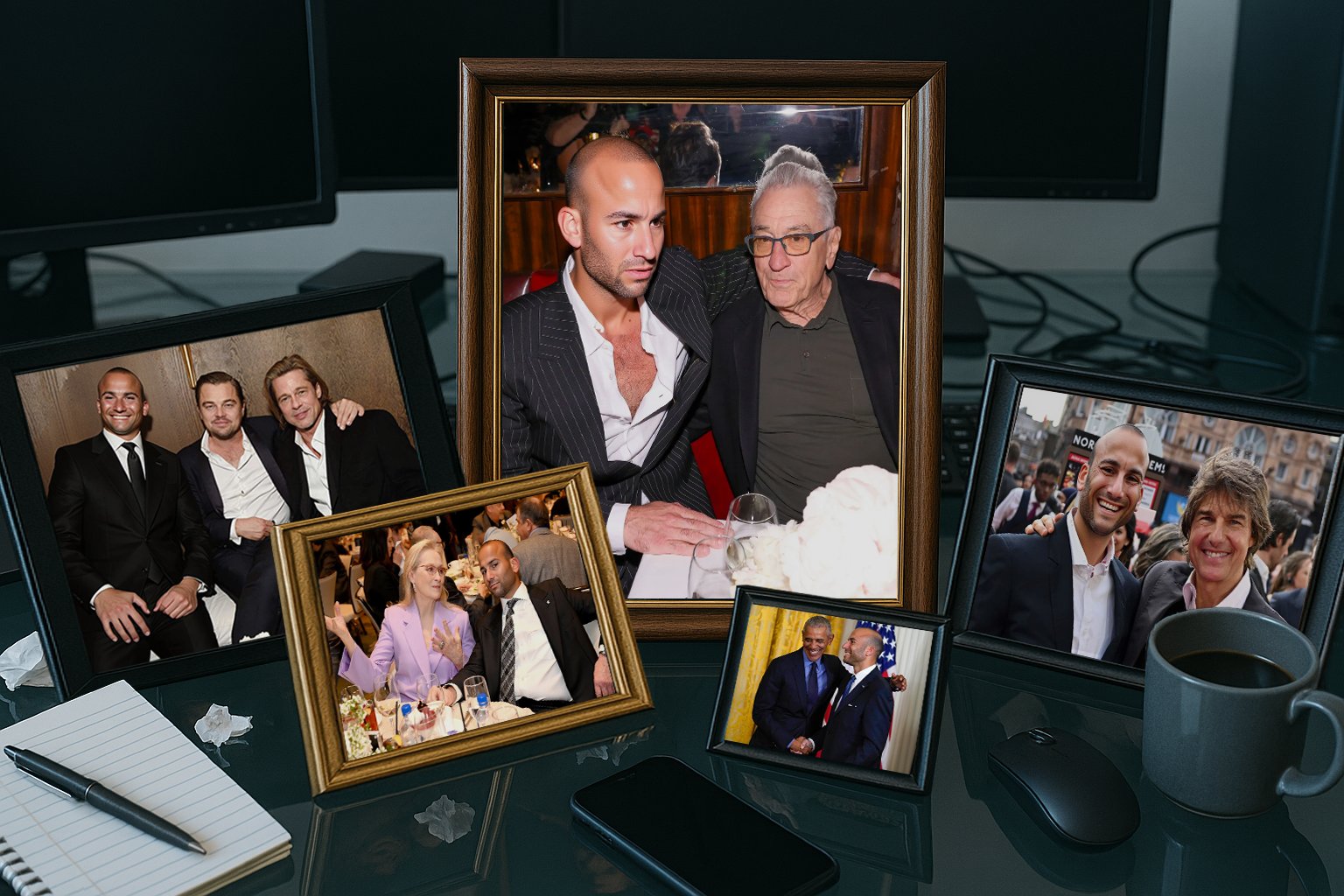
The twisted gallery of algorithmic delusions—my digital trophy collection of encounters that would require massive bribes or federal-level stalking charges to achieve in the flesh.
As a final experiment, I showed some of these images to distant acquaintances without explaining their origin. The reactions were telling—immediately increased interest, subtle status recalibration, assumptions about my connections and social standing.
"How do you know Meryl Streep?" asked one person, their tone shifting to one of impressed deference.
"I don't," I replied.
Perhaps the most valuable thing now, in this strange new landscape of artificial proximity, is the memory that cannot be documented—the genuine encounter that exists only in experience rather than evidence.
I was reminded of this when, by genuine coincidence, I found myself in the same small bookstore as a well-known actor whose work I've admired. There was no photo, no documentation of the brief nod of acknowledgment we shared between the shelves of used books. No one would believe it happened, and I have no evidence to offer.
Yet that momentary, genuine connection—human to human, undocumented and ephemeral—felt more real than all the perfect, fabricated images in my growing collection of synthetic proximity.
In the meantime, my gallery of famous "friends" continues to grow, one algorithmic approximation at a time. A collection of memories that never happened, with people I've never met, in a life adjacent to fame that exists only in digital space—a strange new kind of hallucination that we can all share.
This investigation was conducted under the influence of nothing stronger than curiosity and the strange vertigo that comes from staring too long at convincing evidence of things that never happened.