
There's a new drug on the streets of America, and it doesn't come in baggies or pills. It comes in pixels. The dealers aren't shady characters on street corners—they're billion-dollar tech companies with clean websites and cheerful sans-serif fonts promising you the ultimate high: yourself, reimagined endlessly, perfected digitally, multiplied infinitely.
When Narcissus stared into that pool of water, he at least had the decency to drown. We've invented a bottomless reflecting pool that stares back, and we call it progress.
THE GREAT MULTIPLICATION
Last Tuesday, I counted forty-seven versions of myself scattered across my hard drive like digital confetti. Me as an astronaut. Me as a samurai. Me with the kind of chiseled jawline that nature, in her finite wisdom, had cruelly denied me. Each one more convincing than the last, each one more divorced from the sagging meat-reality I confronted in the bathroom mirror each morning. This isn't vanity—it's existential fragmentation on an industrial scale.
The geeks in Silicon Valley have unleashed a terrible weapon on an unsuspecting public. Not content with addicting us to the dopamine slot machines in our pockets, they've now given us the ability to fragment ourselves into infinite parallel identities. The technology arrived with the benign promise of "fun" and "creativity," those twin Trojan horses of the digital age that always seem to be wheeling some new horror into our cultural citadel.
What strange compulsion drives otherwise rational primates to create digital effigies of themselves doing things they'll never do, being people they'll never be? I've spoken with housewives in Ohio who maintain folders of themselves as runway models, accountants in Nevada who've generated images of themselves as Viking warriors, teenagers in Massachusetts with hundreds of variations of their faces plastered onto bodies they'll spend the next decade trying to achieve through protein shakes and cruel gym regimens.
It's not just a pastime. It's a mass psychological experiment with no control group.
THE NEW NARCISSISM
The Greeks knew the score. Their myths didn't celebrate Narcissus—they drowned him. They understood that excessive self-fascination was a trap, not a virtue to be promoted with cheerful marketing copy and monthly subscription plans.
"This isn't normal," whispered a digital imaging expert who works for one of the major AI labs. We were sitting in a sterile coffee shop in Palo Alto, his eyes darting nervously to the exits as if his corporate overlords might burst in at any moment to silence him. "We've created a technology that exploits a vulnerability in human psychology we barely understand. It's like we've handed everyone a personalized hall of mirrors and told them to find their way out."
He wouldn't let me use his name. I started calling him Deep Fake in my notes. "The average user generates over a hundred images of themselves in the first week," Deep Fake continued, stirring his seven-dollar latte with the intensity of a man defusing a bomb. "By month three, that number often reaches the thousands. We're seeing people delete vacation photos to make room for their AI-generated selves. Real memories replaced by synthetic possibilities."
The numbers are staggering. Three billion digital doppelgängers created in the last year alone. If printed and stacked, they would reach the moon and back seventeen times. A tower of fake selves stretching into the cosmos like some demented digital Tower of Babel.
The question isn't whether this technology is changing us—it's how quickly and how profoundly.
THE DEATH OF ACCOMPLISHMENT
"I used to dream about climbing Everest," a 34-year-old software developer from Seattle told me. His apartment walls were covered with framed images of himself at the summit of the world's highest peak, triumphant in goggles and climbing gear, the curvature of the Earth visible behind him. "Now I've got dozens of pictures of myself doing it. Somehow, that scratched the itch."
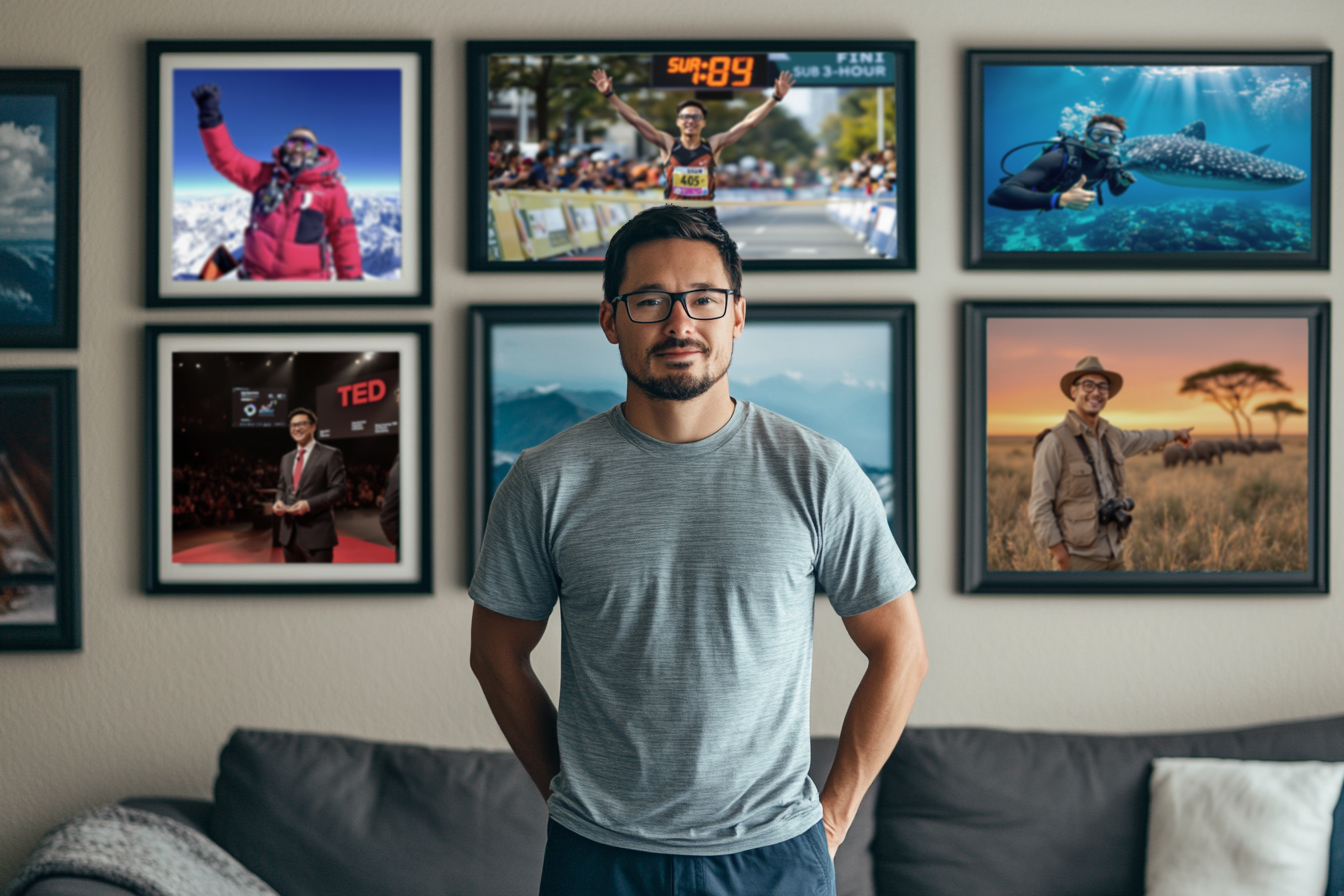
A software developer poses in front of his wall of "accomplishments".
He's never set foot in Nepal. Never felt the thin air of high altitude burn in his lungs. Never pushed his body to its limits against the cruel indifference of nature. But he has the pictures. Perfect, convincing evidence of an achievement that never happened.
This is the digital equivalent of stolen valor, except we're stealing it from our own potential selves—the selves that might have actually done the hard work, endured the pain, earned the triumph. "Why put yourself through all that when the picture looks the same either way?" he asked, genuinely puzzled by my discomfort.
Why indeed. A question that cuts to the bone of what it means to be human in an age where the evidence of experience has been decoupled from experience itself.
THE MADNESS OF CROWDS, DIGITIZED
At a dimly lit bar in Brooklyn, I interviewed a woman who runs a digital identity consulting firm—a job title that didn't exist three years ago.
"People come to me when their digital selves start causing problems for their actual selves," she explained, sipping something brown and expensive. "Like the guy who generated thousands of images of himself as a fighter pilot, then started experiencing sleep paralysis where he was falling from the sky. Or the woman who created so many variations of herself with different faces that she started having panic attacks when she looked in the mirror. "Are these extreme cases?" I asked. "For now," she replied with the weary certainty of someone who knows which way the cultural winds are blowing. "But we're heading toward a world where most people will maintain multiple digital identities as casually as they maintain social media profiles today. The psychological effects are... unpredictable."
Unpredictable feels like an understatement. We're conducting a mass experiment in identity fragmentation with no ethics board, no oversight, and certainly no informed consent.
THE BLURRING
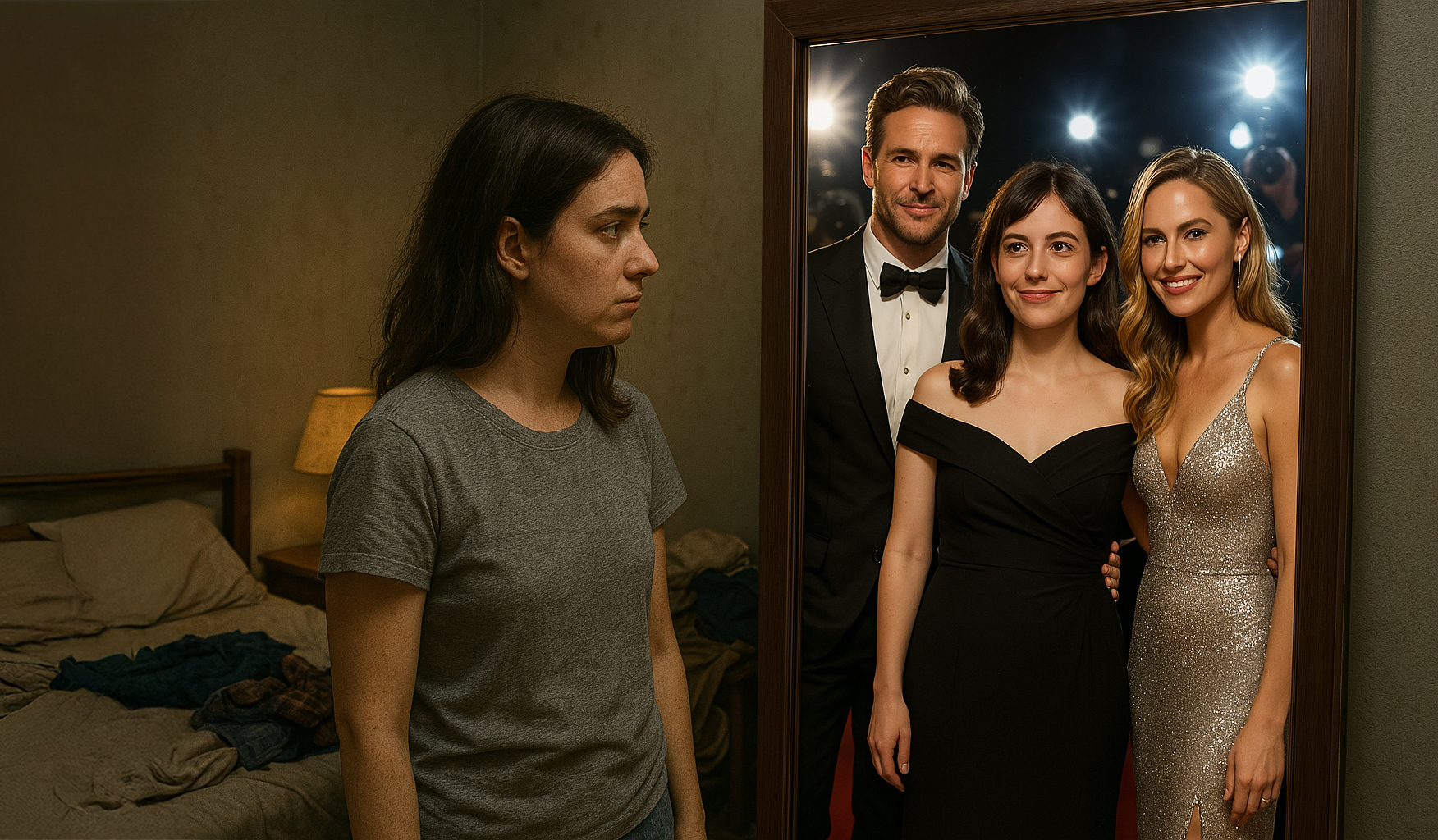
The real horror isn't that we're creating these digital doppelgängers—it's that the line between them and us is already beginning to blur.
"I catch myself posing like my AI-generated self now," admitted a 28-year-old marketing executive in Chicago. "There's this slight head tilt and half-smile that the algorithm always gives me. I noticed I started doing it in real photos, then in real life. It's like I'm imitating a version of myself that never existed."
The algorithm becomes the model, and the human becomes the imitator. A perfect closed loop of digital narcissism, the snake of self-obsession finally devouring its own tail.
Deep Fake, my nervous informant from Silicon Valley, had warned me about this phenomenon. "We're calling it identity feedback," he said, his voice dropping to a conspiratorial whisper. "People start conforming to their algorithmic selves. Changing their appearance, their mannerisms, even their personalities to match the versions they've generated. It's like a form of auto-suggestion, but powered by machine learning."
The machines aren't becoming more like us. We're becoming more like what the machines think we should be.
THE CULTURAL ABYSS
"When everyone can be anyone, no one is actually anyone," intoned a philosophy professor at Columbia with the kind of grave certainty that can only come from tenure or hallucinogens. "We're approaching a singularity of identity, where the proliferation of possible selves leads to a collapse of authentic selfhood."
Outside his ivory tower, I found plenty of evidence for his theory in the wild. Dating profiles featuring AI-enhanced or wholly generated images of their creators. Job applicants submitting artificially enhanced headshots. Political candidates whose campaign materials show them in locations they've never visited, with people they've never met.
Reality isn't just being augmented—it's being replaced, one face at a time.
THE GRIM CONCLUSION
So here we stand, at the edge of a precipice entirely of our own making. A strange cultural moment where technology has outpaced our psychological ability to integrate it healthily into our lives. The Romans built roads that connected their vast empire, and we build digital tools that fracture our very sense of self. Every civilization gets the infrastructure it deserves.
"I don't know how to feel about my existence anymore," admitted a 22-year-old art student in Portland, scrolling through hundreds of variations of herself on her phone. "Which one of these is the real me? All of them? None of them? Does it even matter?"
That's the question that keeps me up at night, staring at the ceiling fan as it cuts the darkness into manageable segments. When reality becomes optional, what anchors do we have left? The digital doppelgängers aren't coming—they're already here, living in our phones, our computers, our social media feeds. Staring back at us with our own eyes, wearing our own faces, leading the lives we could have had if only we weren't busy creating digital versions of ourselves leading lives we'll never have.
The ultimate hall of mirrors isn't made of glass and silver. It's made of algorithms and pixels, and unlike Narcissus, we may never find our way out of the reflection.
But god damn, do we look good in it.